Before opening my eyes in the softness of the pre-dawn dark this morning, I knew it would be another day of gloomy, somber gray skies and blustery winds.
The wind, although not howling or storm-worthy, had been steadily moaning through the leafless branches outside my bedroom window all night – as it has for much of the past week. Dreary days like this make good spinning days, but not much else.
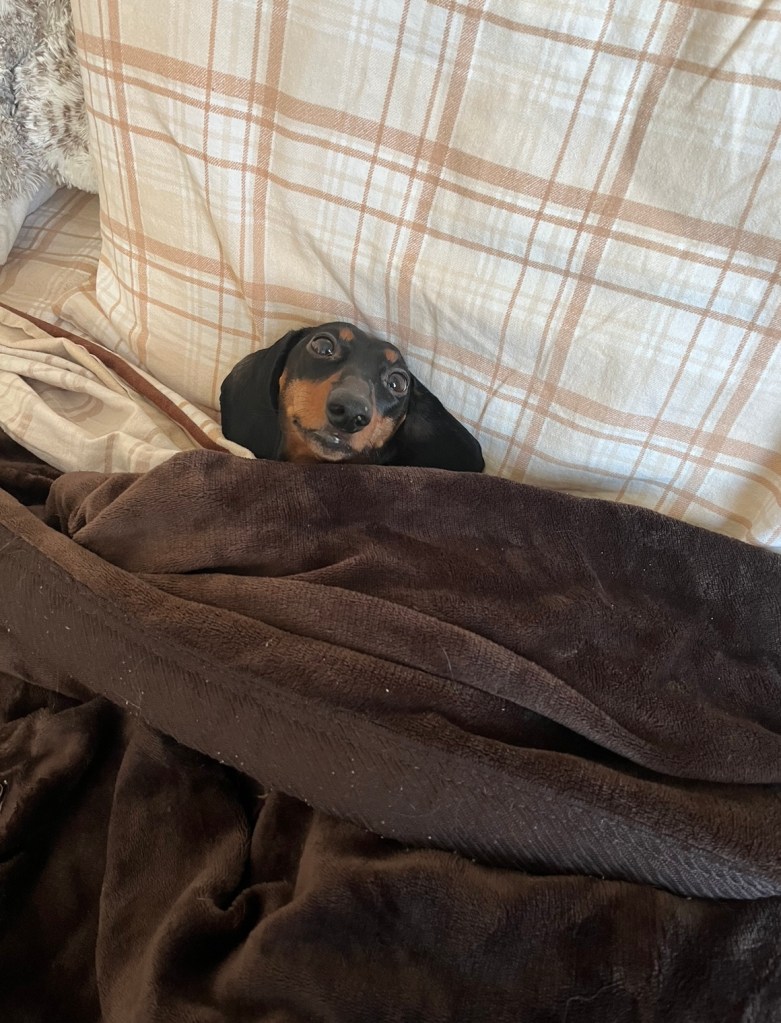
Still, I awoke with a smile and although it was time and past to rise, I enjoyed several more minutes snuggled under warm blankets with not one, but two warm dachshund bodies glommed close to my side, snoring lightly.
Peace, quiet and warm dogs. What a lovely way to wake up.
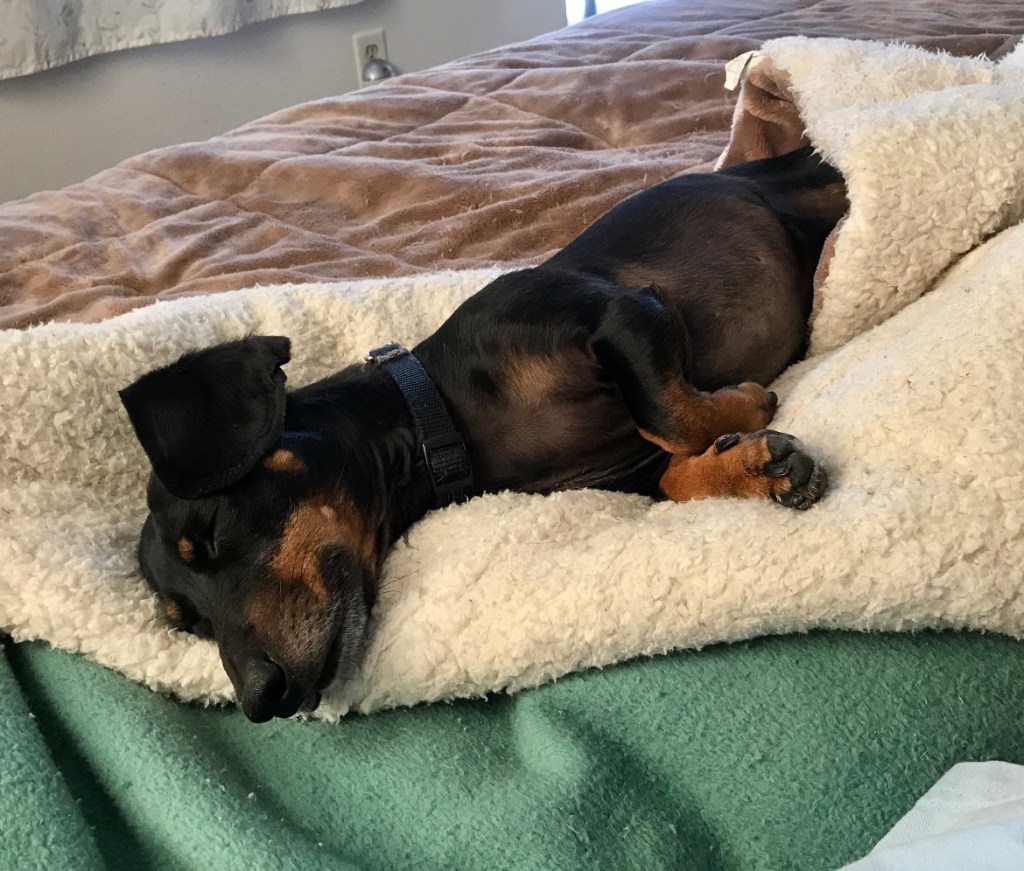
Nevertheless, my desire for coffee eventually won out and I gently freed myself from the blankets and warm fur. Uncovering toes and warm bellies earned me groans and stretches, and finally a couple of sleepy heads emerged.
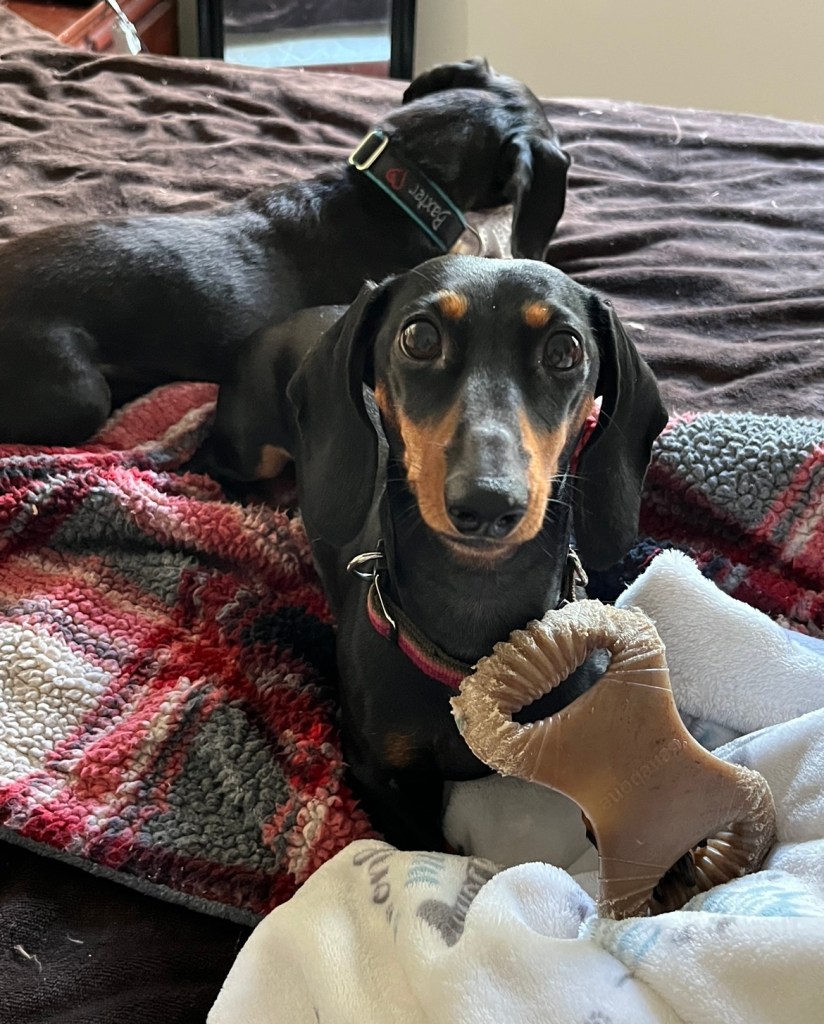
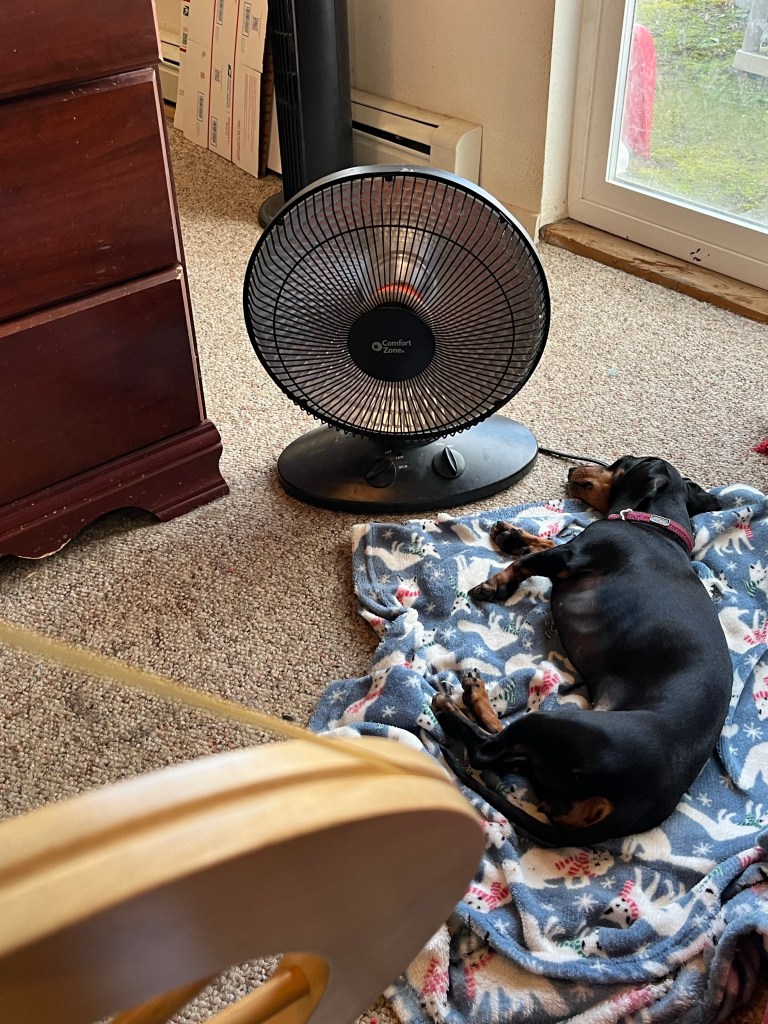
Not sure, but I think these are Ronni toes?Rhonda is not a morning person.Baxter says, “Just five more minutes …”
By the time my upstairs morning routine was completed and coffee was poured, the duo had awakened, scampered downstairs and pestered Jer into bundling up and taking them both outside to potty. Yay Jer!
Coffee mug in hand, I headed back to bed, ready for the rest of our early morning ritual of coffee, biscotti and belly-rubs. I guess this is their version of doggy bagels?
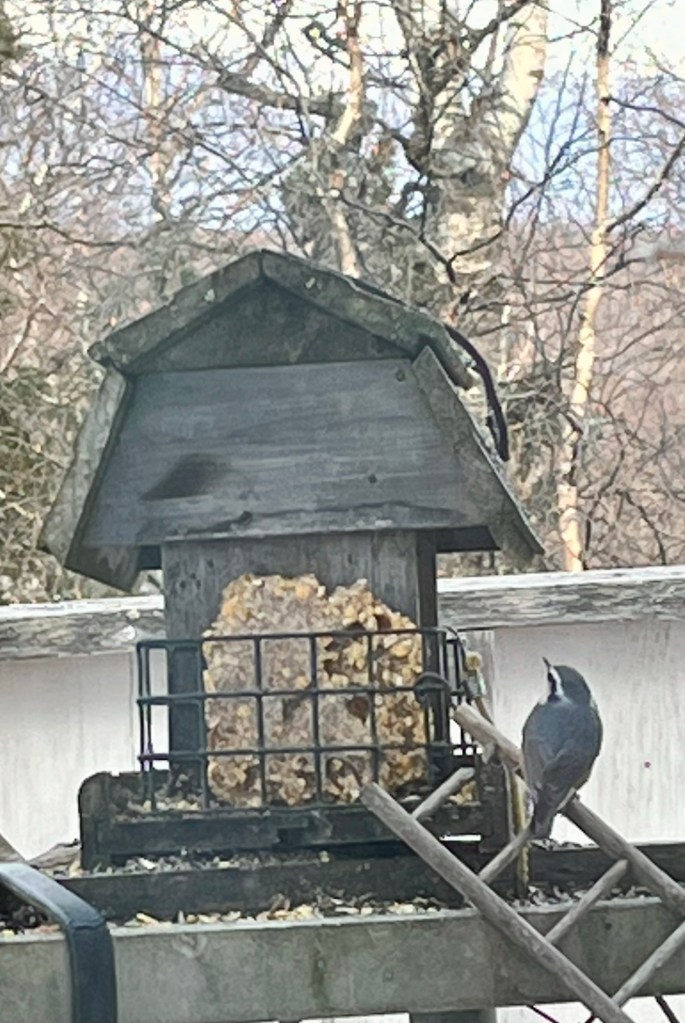
I don’t know exactly why, but I tend to think of the cheeky little red-breasted Nuthatch as the tiniest of the woodpecker clan.
I know they aren’t any such thing, but the way they cling, often upside down, to the suet bar on my deck … peck, peck, pecking away with their sharp little beaks, just strikes me as woodpeckery.
Nuthatches are one of my favorite bird-feeder visitors partly due to their sheer tenacity. Such small but bossy tyrants; they zoom in while I’m filling the feeders, scolding as they supervise, wings whirring – impatient for me to be out of their way.
More than once, I’ve had a nuthatch briefly land on my arm or head, cheep imperiously and dart off, only to return to circle the deck again. Obviously, I am way too slow at refilling those feeders! Nuthatches eat their share of seeds, of course, but suet is their candy. Woe unto me if the suet bar runs low.
The chickadees like suet too, but they approach it in a normal, finch-like manner, landing quickly, nibbling and flitting away.
Actually, the chickadees are much more interested in the BOSS (black oil sunflower seeds), only occasionally bothering with the suet. That attitude will change as winter sets in and the suet holds more nutritional value.
The black-capped chickadees, like the nuthatches, are year-round residents in our area. I see little of them on the deck during the summer when fresh food is plentiful, but they return to the feeders with alacrity as soon as temps plummet. These plump, black and white feather-balls are daily visitors from September through April.
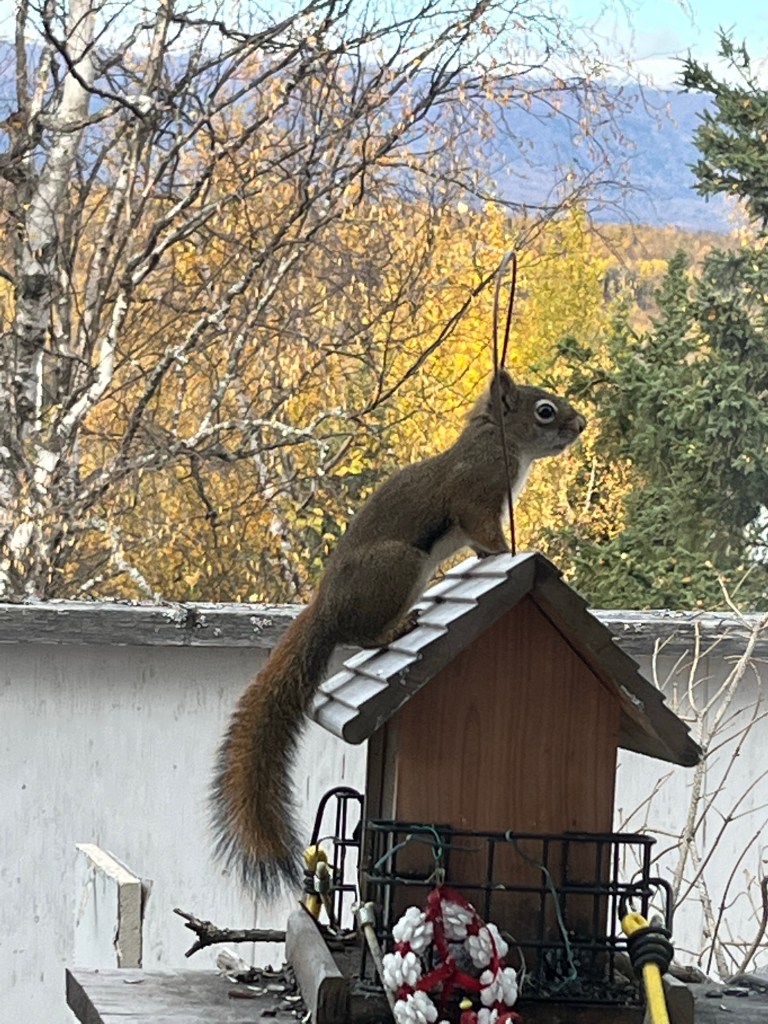
Fortunately, these two little bird species co-exist happily side by side at the feeders, something that can’t be said for our single resident red squirrel.
Our squirrel is a bit of a bully, and while I don’t mind feeding him, I don’t like it when he actively chases the birds off the feeders.
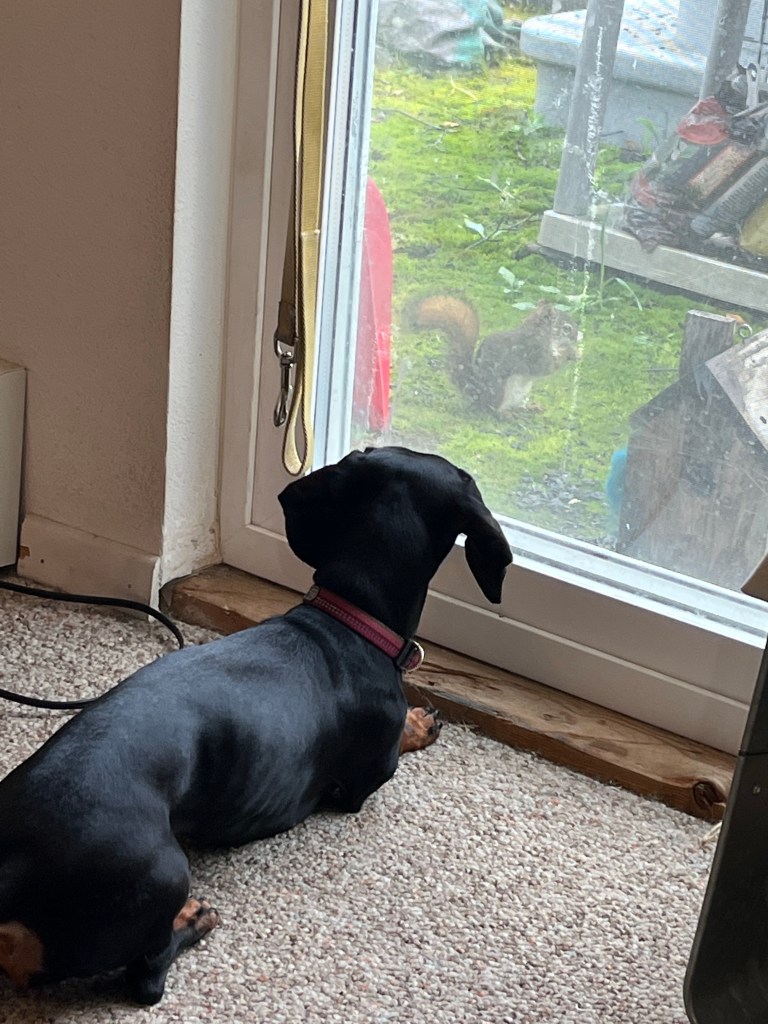
I guess that’s partly why I not only allow, but encourage and enable Rhonda in her daily bouts of squirrel hunting. 🐿 It’s not likely she’ll ever catch this particular furry prey, since the squirrel is fast and Ronni is limited by a 6’ leash, but she has come close enough times to keep the game entertaining – and it keeps the squirrel on its toes.
I figure as long as the squirrel is busy keeping an eye on the dog, he has less time to harass the birds whose seeds he is sharing. Win-win.
I would, by the way, happily allow Ronni free reign on the deck for squirrel chasing purposes, but she’s already proven capable of weaseling under the deck railing. Visions of her recklessly flying off the second-story deck in pursuit of a squirrel has me coming down on the side of caution. Thus the leash.
Other notable upper deck denizens who’ve already made their first appearances this season are the brightly garbed Hairy Woodpecker and it’s equally pretty, if much smaller cousin, the Downy Woodpecker.
I’ve been watching for the appearance of one of the Hairy woodpeckers today, but the loud rat-a-tat-tat of his hard beak against some nearby trees tells me he’s still finding plenty of bugs at this point.
The most recent new arrivals on the deck have been a pair of Dark-Eyed Juncos who arrived just the other day. These mousey little birds are marginally larger than the chickadees, but much quieter in manner and markings. Their large, dark eyes seem always to be watching for danger. It may be they are just passing through on their way to more familiar surroundings.
I believe it’s the male Junco who is more of a soft, slate gray with a slightly darker head, while its mate (I’m presuming) is a mouse-gray/brown color, also with a slightly darker head. They haven’t actually gone to the feeders, but rather peck around the deck floor, finding seeds that have fallen there.
The only other visitor so far, and a one-off, I’m pretty sure, was a lone (quite large!) Canada Jay, who stopped by a couple of weeks ago for a snack … probably on its way back to Canada?
I truly enjoy and appreciate my fall/winter deck denizens. They bring such cheerful life and movement to my little bedroom fiber studio during the quieter, chillier winter months, asking in return for only a simple buffet of seeds and suet. Yes … even the dastardly squirrel.
I’ll begin by saying I was awful at math as a child and avoid it like the plague to this day. Thank God for calculators.
That being said; I have become fascinated by the idea of creating fractal patterns in yarn.
A fractal, in the math and science world, is a never-ending pattern or a repeating pattern with the potential to repeat on and on in ever- decreasing size. I won’t take it quite that far, but the same basic definition applies when creating a fractal-spun yarn.
A fractal is created by repeating a simple process over and over in an ongoing feedback loop. By taking the same pattern and making it smaller, you can repeat that same pattern multiple times in the same amount of space.
If you think about it, you’ll find fractal patterns to be pretty familiar, since nature is full of fractals. A fern leaf is an easy to visualize fractal pattern.
Whole fern frond, each individual branch, individual leaves on each branch, etc. A repeating fractal pattern in nature.
Fractal spinning takes this idea of repeating patterns at different scales and applies it to yarn, starting with a length of hand-dyed fiber (I’m using wool). The repeat pattern will be in the colors used. Once it is spun up, the finished yarn will have two or more (sometimes many more) different scales of the color repeats found in the dyed fiber.
Are you still with me?
I’m starting my project with three large, 4 oz. skeins of yarn, using hand-dyed Cheviot wool roving in three different colorways.
Each colorway graduates from light to dark, which will play an important role in the planning process for the finished yarn. I’ll be creating not only a fractal yarn, but a color-gradient fractal yarn.
Let me walk you through the process I used. By the way, there are a myriad of ways to creat a fractal spun yarn. This is simply the direction I chose for my yarn.
I’ll use the orange (fall foliage) gradient as my example, but will follow the exact same prepping process for each of the three color groups. By the way, it took me about three weeks to complete this project, working on it as time allowed.
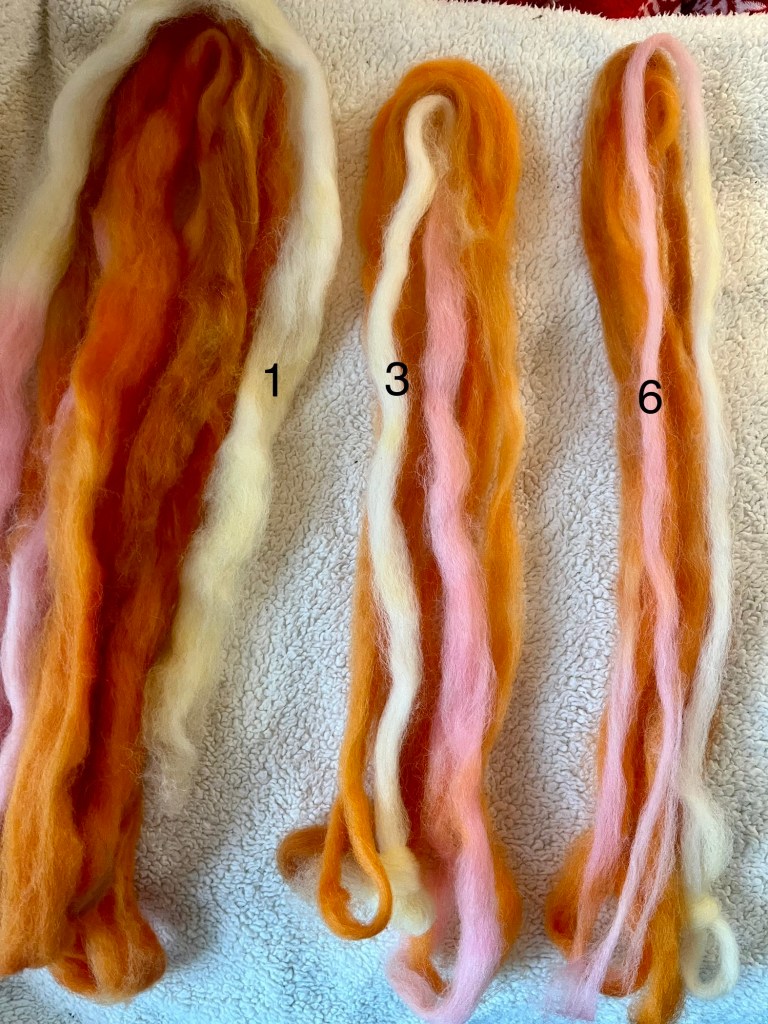
Taking first the 4 oz length of yellow/orange/brown roving; I split it lengthwise, pulling it into three equal-size strips, each 1 1/3 oz in weight. A digital kitchen scale comes in real handy here, although eye-balling the size is fine, too.
I set one 1.3 oz strip aside. The other two strips were then divided lengthwise into three more strips each.
Three of the six medium-size strips were set aside as is. I then took the last three medium-size strips and split each in half lengthwise, ending up with six much smaller full-length strips.
Each strip of wool roving, although now separated into three different diameters, are identical in the gradient color change from pale yellow at one end, through orange shades and ending in brown at the far end. They are all the same length.
Original roving.Divided into 3 groups; 1 large, 3 medium, 6 small.I rolled each individual length of fiber into a “nest” and prepared to spin.
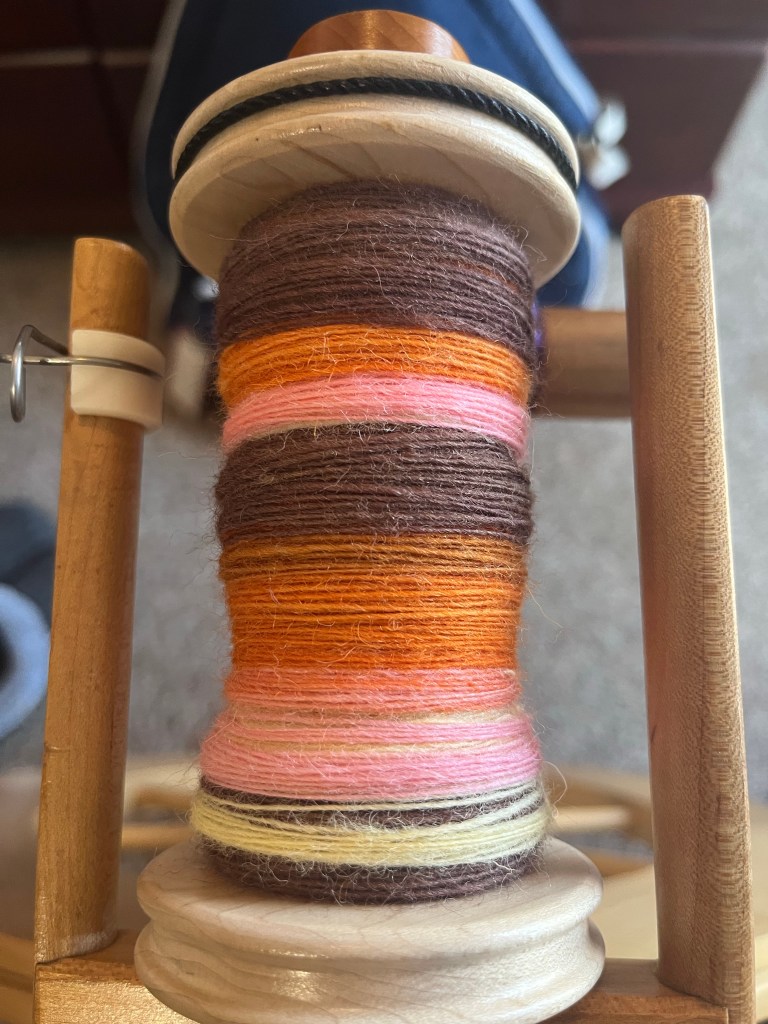
Size matters! The plan is to use three bobbins; first spinning the largest roving – beginning the spin at the pale yellow end and, finishing one color before moving to the next, gradually moving along from one color to the next, ending by spinning the brown. I took this finished bobbin, with just the single, straight-through color repeat, off my wheel, replacing it with a fresh bobbin.
Here is where the fun starts. On the second bobbin, I spin all three medium-size strips, always starting with pale yellow and ending on brown – one after the other – a repeat of the same exact pattern three times. Since they are narrower strips of fiber, I can move from color to color more quickly than on the first bobbin, which keeps me interested. I removed this bobbin from my wheel and set it with the first bobbin.
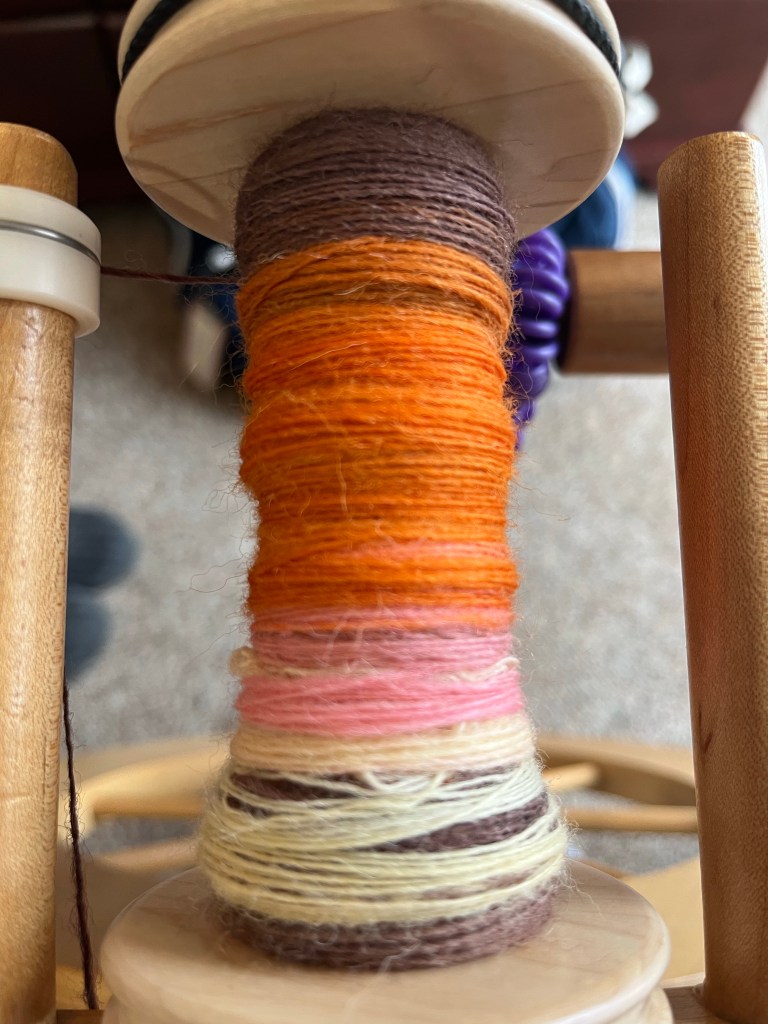
Have faith! It doesn’t look like much at this stage of the spin – but all those colors are in there!
Placing another fresh bobbin on the wheel (are you beginning to understand why I had to clear off all those bobbins last week now? 😉), I’m ready to tackle my last series of pattern repeats.
This time I am spinning all six smaller, pencil-thin strips of fiber, one after the other, starting as always with pale yellow and ending with brown. Having less fiber to work with, this moves quickly from color to color and gives me six repeats of the exact same gradient color pattern on this bobbin as are on the other two bobbins.
In case you lost track; I now had one bobbin with a single, fat run of the color gradient from yellow to orange to brown, one bobbin with three repeats of the same color gradient, and one bobbin with six repeats of the same color run. Each bobbin holds approximately 1.3 oz of Cheviot wool.
It might seem strange to some, but I found the decision making challenge of creating this yarn both mentally and artistically satisfying. Figuring out how many repeats would be enough (too many will tend to muddy up the final yarn, losing clarity) comes through trial and error.
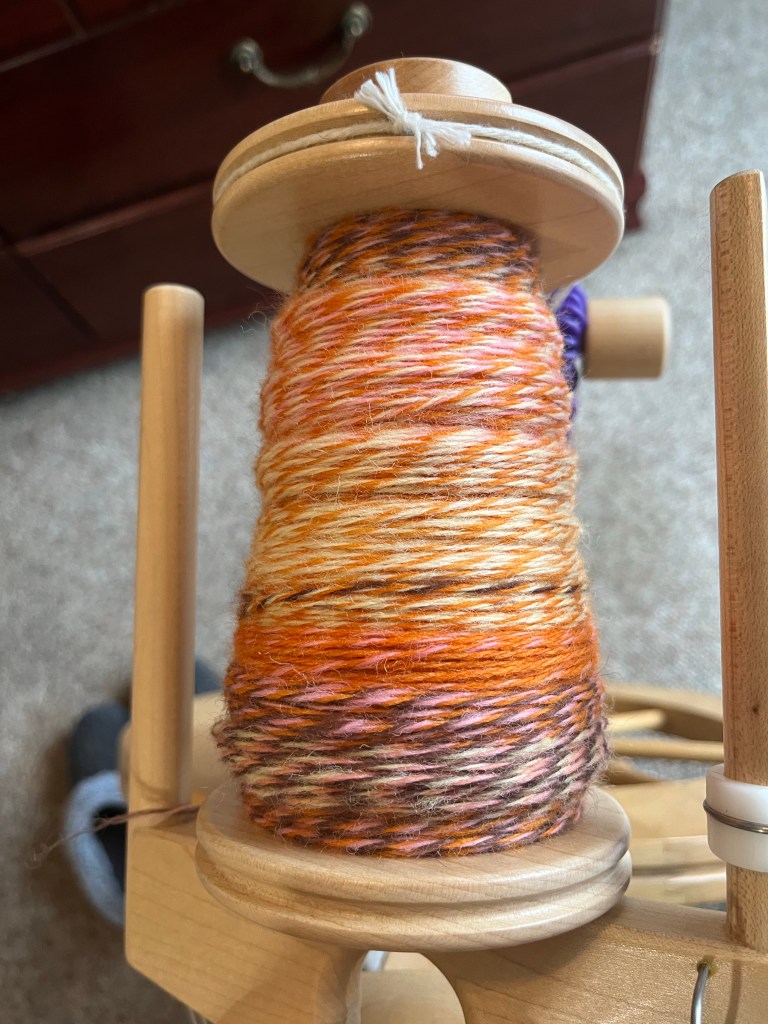
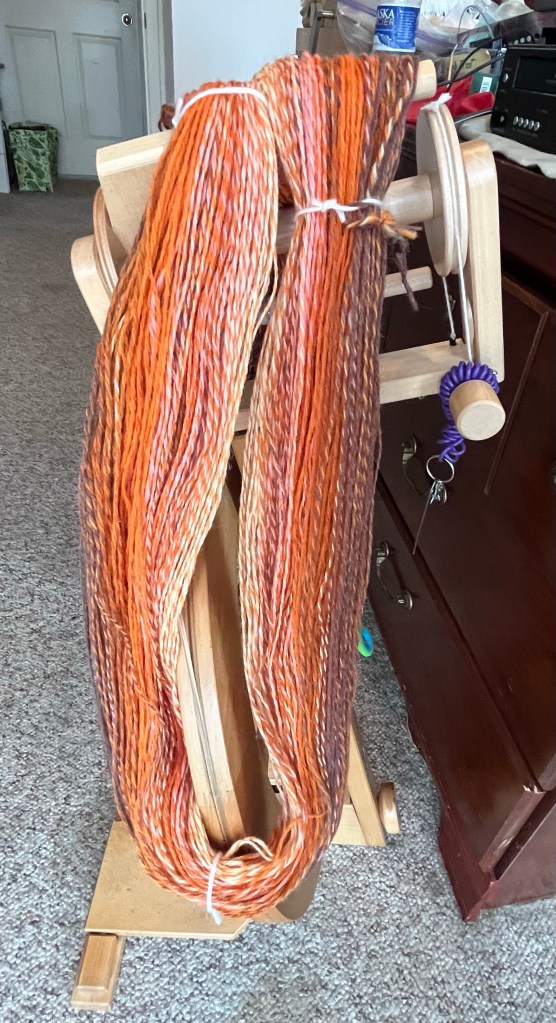
Now the magic happens (and talk about delayed gratification – that was a lot of spinning). I placed all three bobbins on my tensioned Lazy Kate, switched out my regular-size flyer and bobbin for my larger Jumbo Plying flyer and over-size bobbin on my spinning wheel … and plied the three separate bobbins together into a single, 400 yd 3-ply yarn.
Each bobbin held a single part of the final three-ply yarn. To ply, you spin the three singles together but spinning the wheel the opposite direction that you spun the original singles. It takes some practice and finger coordination to keep the three singles properly tensioned and twisting evenly into the ply.
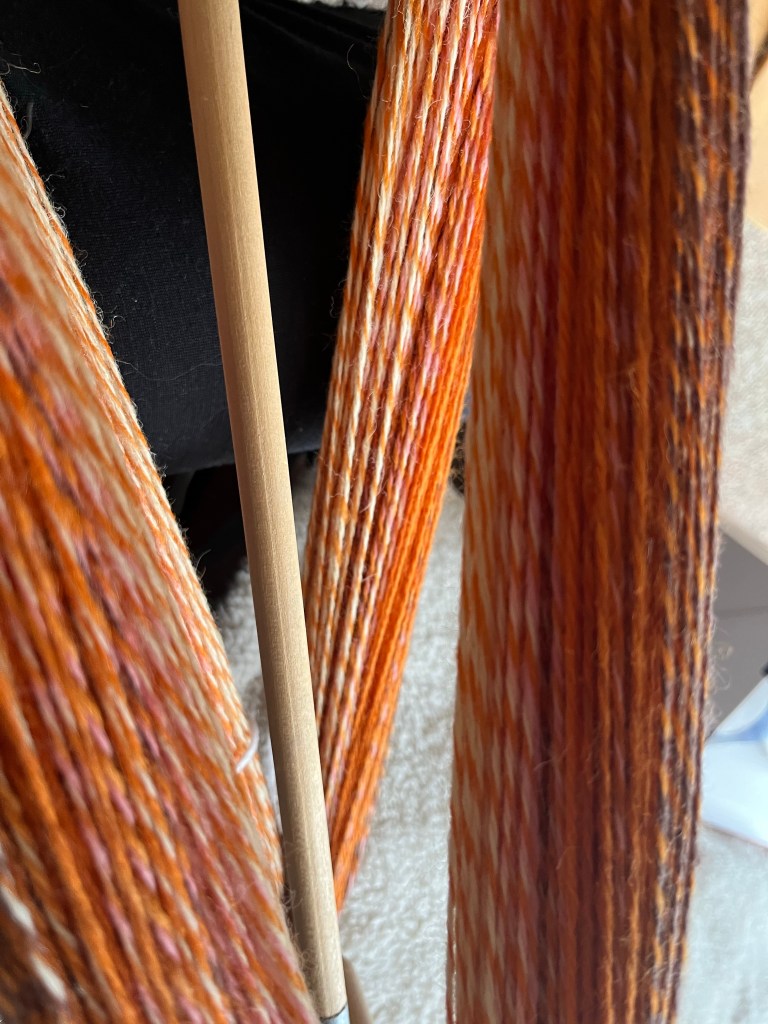
In the final yarn, you will see sections where colors aligned in bright spots of solid orange, yellow or brown and many others where two and even three colors plied together in seemingly wild abandon. However, the finished skein of yarn has an overall pleasant sense of balance and symmetry achieved by the multiple repeats of the original colors.
You can see how I followed the same steps with the dark blue/medium blue/aqua/gray gradient fiber and then the purple/violet/pink fiber.
Blue gradient roving.Single run of color gradient.Run of gradient 3 times.Run of gradient 6 times.
The final plying of the 3 bobbins of shades of blue into a single, 4 oz 3-ply yarn.
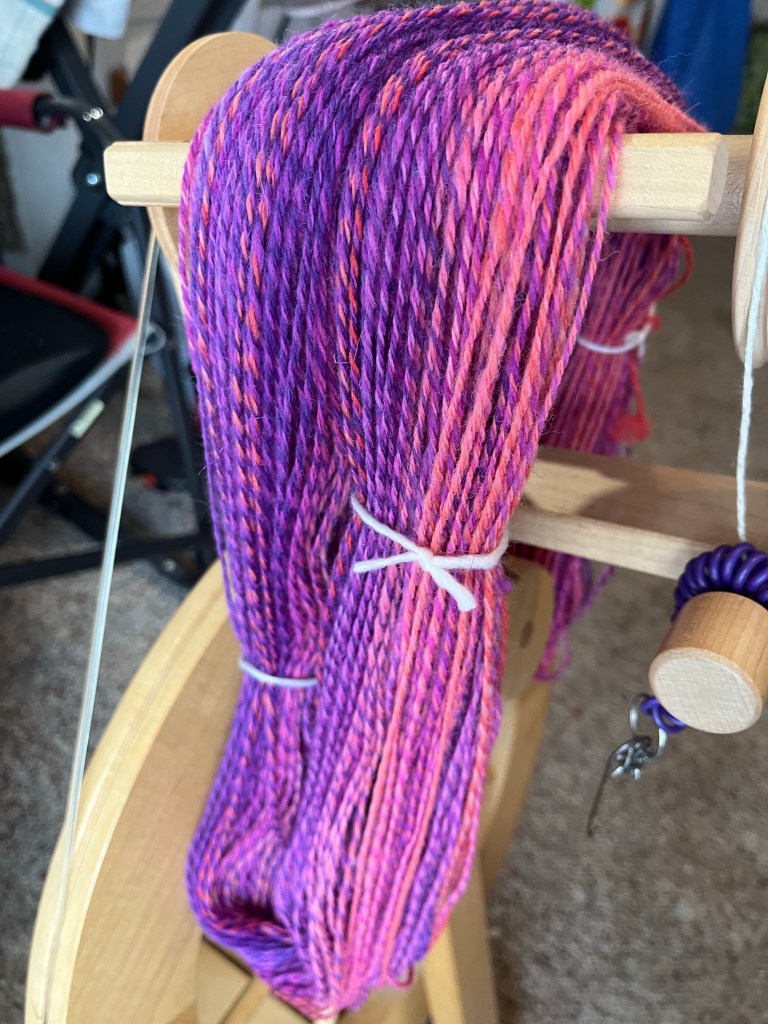
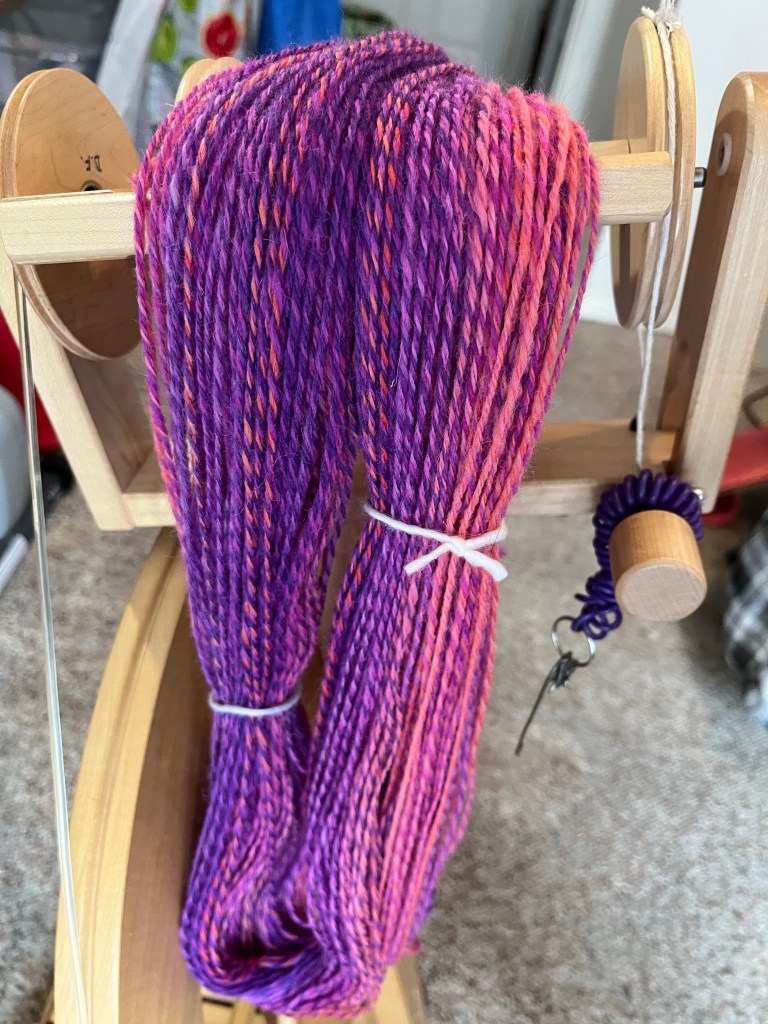
And lastly, using the same process for the pink/violet/purple 4 oz 3-ply yarn.
This shows my larger plying flyer on the wheel. All 3 singles from the smaller bobbins, once plied, fit onto this large bobbin.
This, my first attempts at creating fractal yarn, was satisfying at many levels. It was also my first time spinning Cheviot wool and I couldn’t be more pleased with the bouncy, sport/DK weight yarn it produced.
Settling on 1, 3 & 6 repeats was a choice I was glad I’d made. Had I gone with 1, 4, & 8 repeats, I believe it would have given the browns and grays to many opportunities to muddy up and overpower the softer shades.
It was just a quiet Saturday afternoon. The sky was a pale, bruised gray threatening but not quite producing rain.
Saturday was Rhonda’s weekly Barn Hunt practice, where she had enthusiastically cornered and pounced upon four craftily hidden, furry rodents (all safely ensconced in their protective tubes).
Much romping, climbing and tunneling was done by my 4-legged partner, with me, her teammate, scrambling along in her wake, picking up found rat tubes and trying to keep an eye on where Ronni was heading next.
A successful hunt and lots of fun was had and chauffeuring duties complete for the day, I figured Ronni would be content with my tentative afternoon plan of curling up for an hour or two with a good book when we got home. I mean, hey … it was that or clean kitty litter boxes.
Once home, although Rhonda was indeed happy to curl up for a nap, I found myself antsy and unable to concentrate on my book. After reading the same page several times, I tossed the book aside and picked up my Spin-Off magazine. Interesting articles; fleece, fiber, spinning and yarn … oh my. But my mind continued to wander.
Maybe I’d pick the magazine back up later, but for the time being, I needed something to keep both mind and hands busy.
OK, OK … litter boxes having been freshened and 15 minutes put in on the stationary bike, it was time to move on to something more entertaining. I needed a project. Maybe it was the changing weather, changing seasons, changing routines … but I found myself unable to settle.
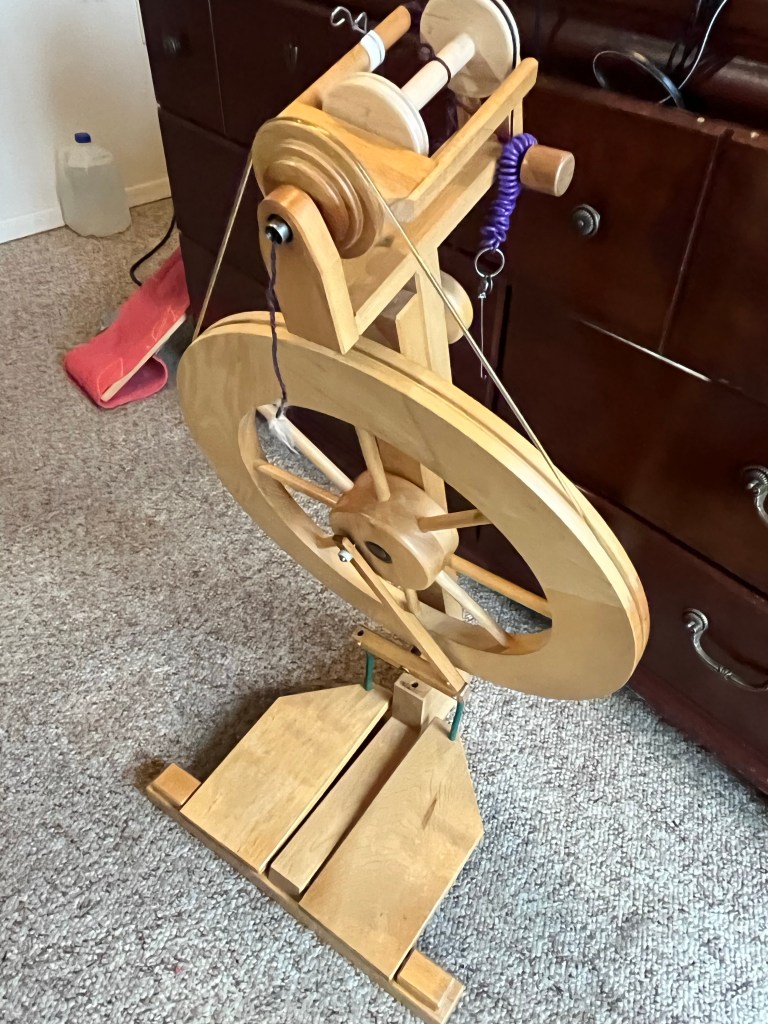
Finally, turning my spinning wheel so it faced the glass door to my upper deck for bird watching, I sat at my wheel and began to spin. Yep, this felt good. There is little in my world more mind-calming than spinning. My constant companion, Ronni, agrees.
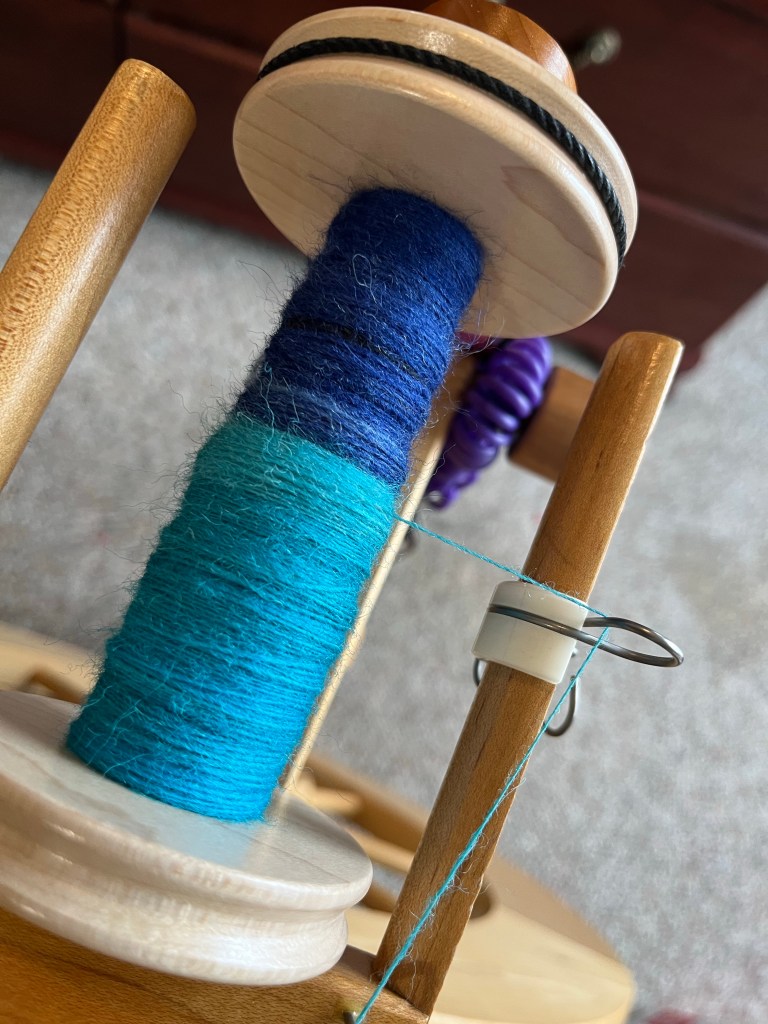
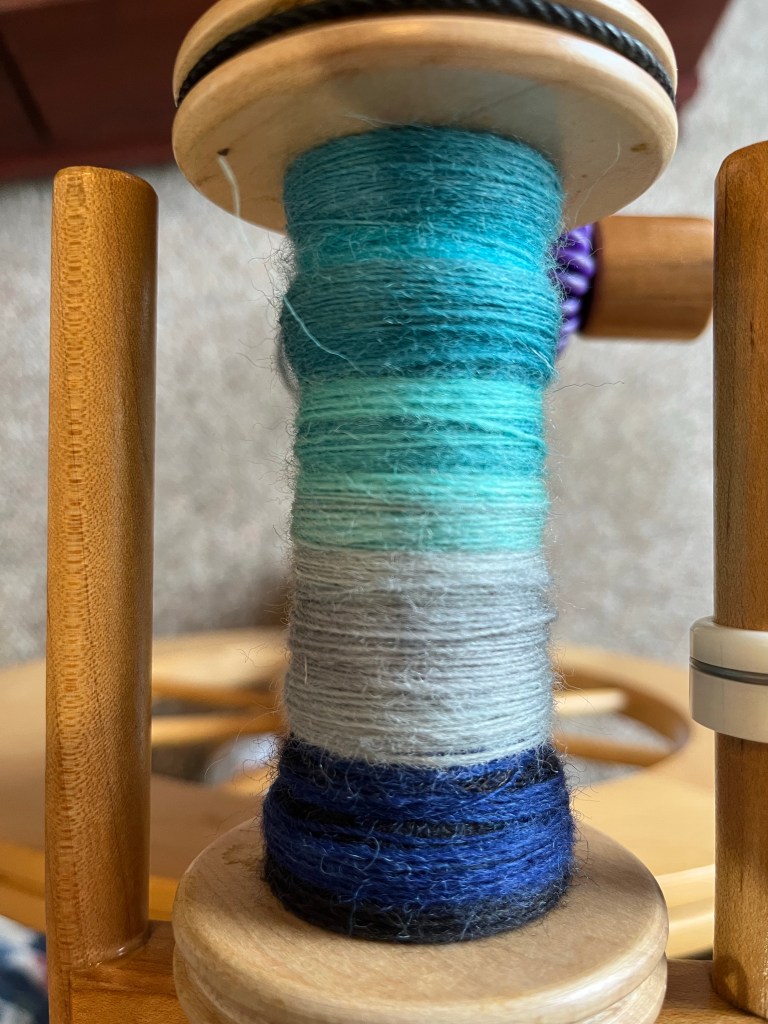
Over the next couple of hours, I treadled away, filling the bobbin on my wheel with luscious shades of blue and aqua in a fine Polwarth (wool)/silk blend. The silky fibers moving through my hands were reminiscent of the feel one would get petting a particularly soft, warm cat. Relaxing and soothing.
Lovely fiber!A bobbin half full of lovely fiber.
Just as I love traveling in my RV in summer, spinning is my wintertime happy place. I may as well get comfortable.
With one bobbin full and half of the roving yet to spin, I went to my fiber closet, where I discovered to my dismay that, darn it, I was out of bobbins. Oh, woe is me.
Now, this is not to say that I didn’t have any more bobbins. It simply meant I didn’t have any more empty bobbins. This was going to be a serious case of delayed gratification. Well, I did say I needed a project. 🤷🏼♀️
Thus started a long-procrastinated bout of bobbin clearing. 🧵🧵🧵
Impatient though I was to continue spinning the pretty blue Polwarth blend, it would have to wait a bit. Besides, bobbin clearing still involves spinning and plying and I enjoy both for the pure sake of the process, so this was no real hardship. Switching gears, I went off in search of partially filled bobbins.
My spinning/spindling followers will already understand the necessity for clearing bobbins periodically, especially if they don’t have an abundance of them to begin with.
For everyone else, I’ll explain. In order to create yarn on a spinning wheel, one needs bobbins. Preferably lots of bobbins, but at the very least, a few. To make 200-300 yards of a simple two-ply yarn, I need a minimum of three bobbins; two to spin up the single plies, and one to ply the two singles together into a two-ply yarn.
The more plies you want your yarn to contain, the more bobbins it takes. For example; in these pictures, you can see the three bobbins on my Lazy Kate on the left, and on the right is the bobbin holding some of the 3-ply yarn being created. Total; four bobbins in use!
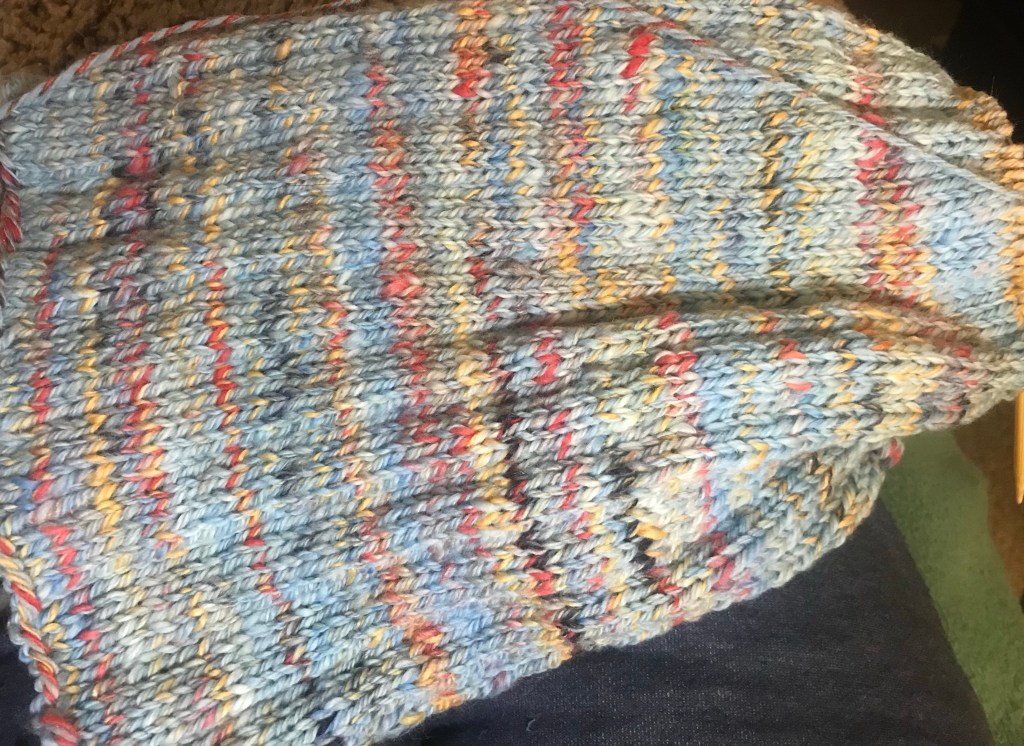
The unique cowl/neck warmer I spun and knit for one of my granddaughters.
Now, if you know me, you should know I’ve often got more than one project going at the same time, be it multiple small samples spins, single-color spins I’m thinking about plying together (and sometimes end up not using) or maybe I have a desire to spin up a brilliantly dyed, multi-colored roving as a visual break from spinning a large project’s worth of some natural cream or brown fiber. Etc.
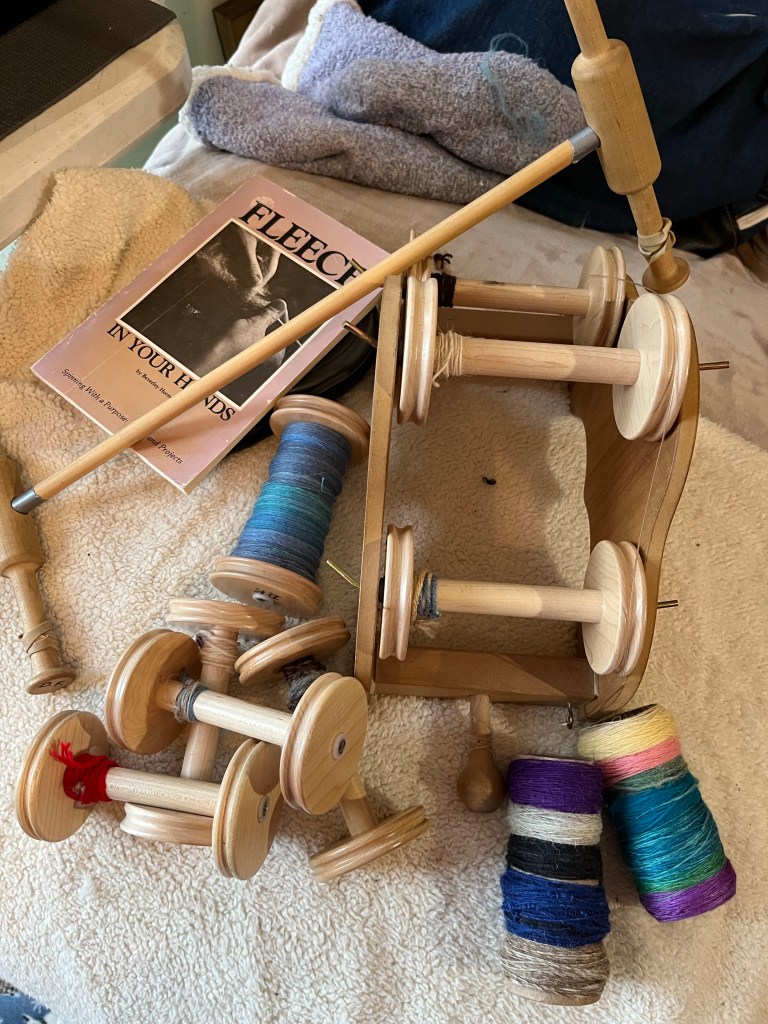
As you can see, lots of bobbins make for a happier me. Maybe I should take up bobbin-juggling as a side job.
Every new project needs bobbins – and seriously , one can hardly have too many bobbins. This week, my goal was to clear a ton of leftover projects off of as many bobbins as possible.
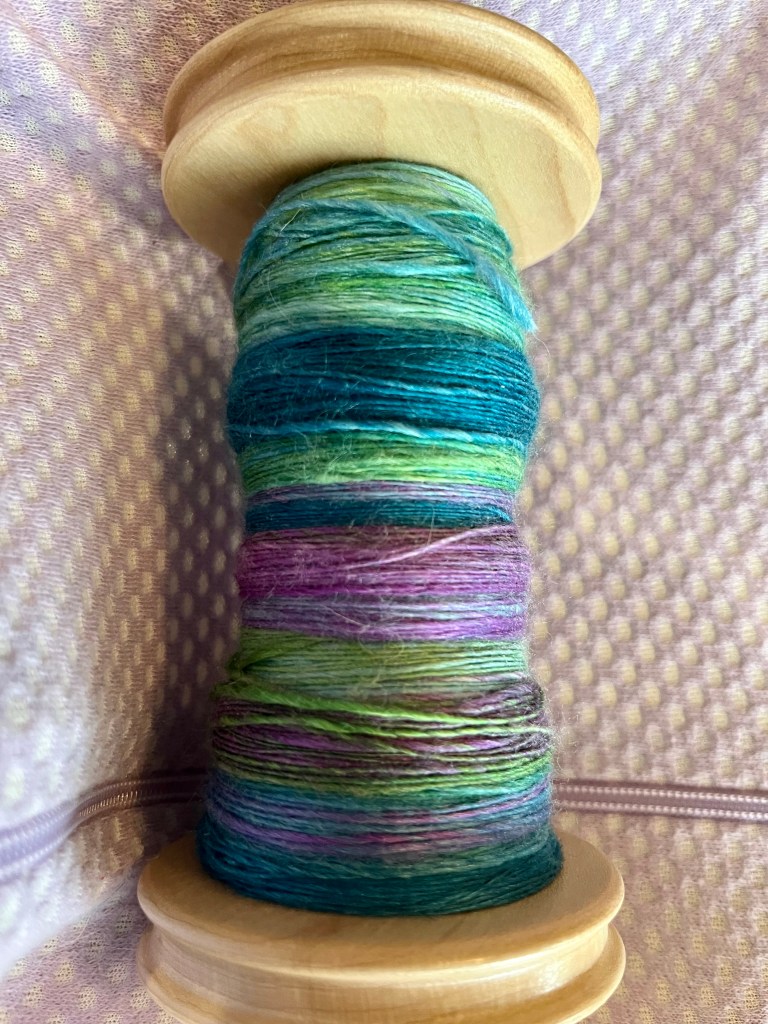
So, I found this pretty, multi-colored blue/green/purple on one bobbin. I think it was leftover from a large project several years ago. I don’t have any more of the hand-dyed merino wool I originally spun this single from, so I need to come up with an alternate plan.
Hmm … maybe I could ply it with this other leftover bobbin of turquoise BFL wool? The colors would blend well and the singles look to be spun at about the same weight. This will work, but there isn’t enough on this short blue bobbin.
OK, off to dig through my stash. YES! I do have more of the turquoise fiber. So, in order to clear both these bobbins, I need to spin more turquoise onto the solid bobbin until it matches the amount on the multi-colored bobbin, then find an empty bobbin to ply them together on. Fingers crossed.
I like the outcome of this necessity-inspired blend. I’m thinking mittens.
Now to search for more bobbins … hmm, this next bunch is going to be more challenging.
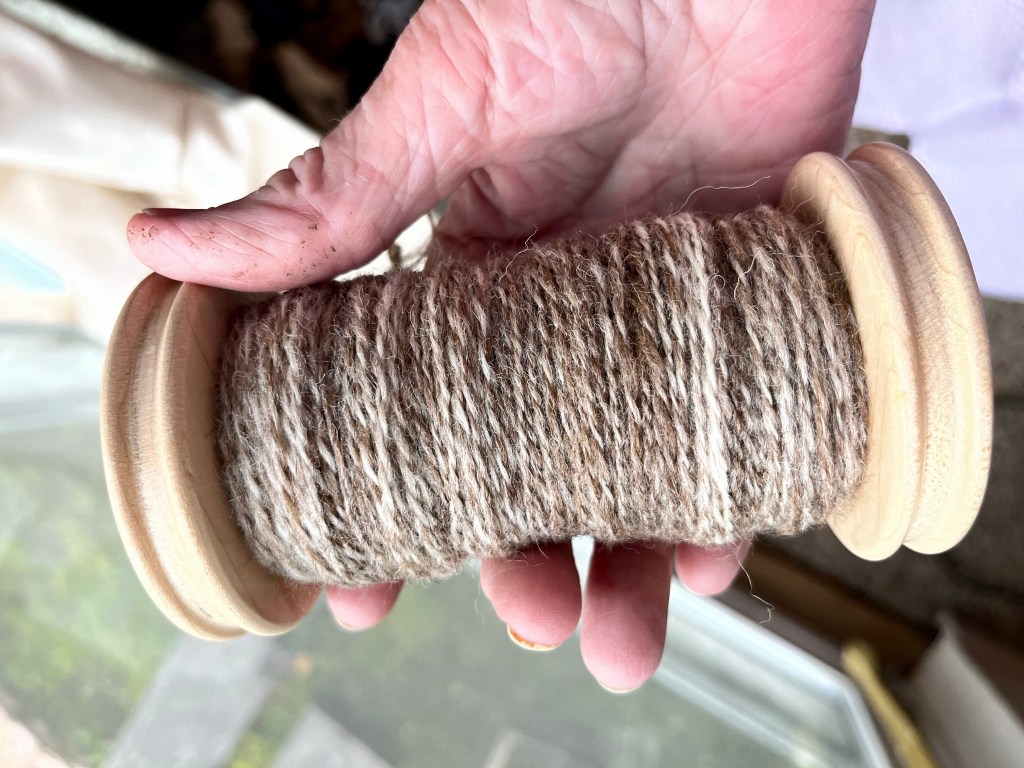
Bright yellow BFL (Blue-faced Leicester wool), dark forest-green Merino wool/silk blend, and medium brown … what? Mystery wool. It feels like maybe a wool/alpaca blend?
These definitely do not belong together. Keep digging …
Progress! I found a bobbin half full of a cream-color wool. Plied together with the brown wool, it created a nice brown and cream 2-ply. Another two bobbins cleared!
Deeper in my stash, I came across two full bobbins of, well, my best guess is an experiment gone wrong? This was something I had to have spun years ago since I didn’t remember it at all.
It looks like I plied two very different singles (possibly wool and mohair?) and I’m guessing I was attempting a new-to-me spinning or plying technique, since this doesn’t look like my usual style. Obviously, displeased with the outcome, I’d simply set the bobbins aside to deal with later.
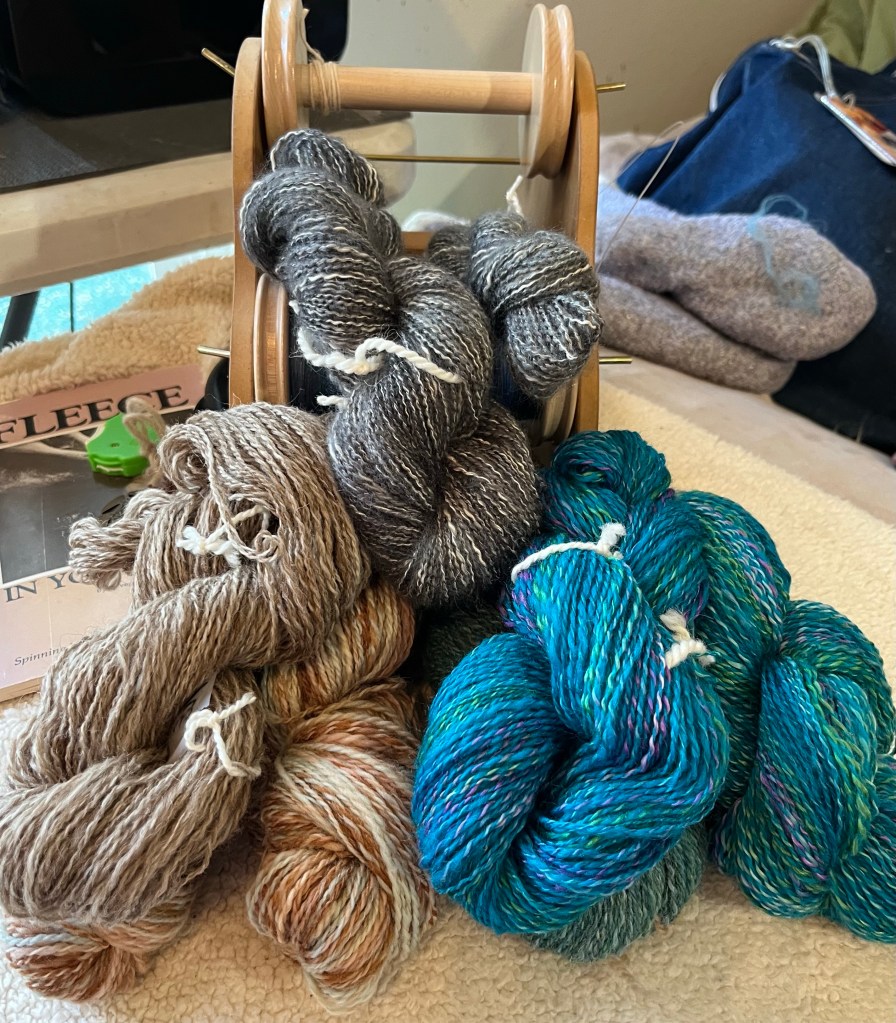
Well, today is “later”. I need those bobbins! Out came my niddy-noddy (the tool for creating a skein from the bobbin of yarn). I now have two skeins of … hmm, art-yarn? Maybe it’ll look better after I’ve washed it and allow the twist to settle. We’ll see.
In any case, it looks like the bright canary yellow and the dark green will have to stay on their bobbins for now. The yellow will come in handy at some point, and I did find a bunch of the forest green merino/silk blend fiber, so I can spin more of that up as a future project. At least the bobbin is now with the corresponding fiber.
Now, several more bobbins later, I’ve managed to clear enough bobbins to continue contentedly spinning for the immediate future. Any last bits of stray singles have been wound onto toilet paper rolls to be stored for … whatever.
Of course, all this bobbin clearing creates yet another dilemma … what am I going to do with all this YARN?





















 De & the Dachsies - Our Rambles